Advanced Therapeutic Tools
Advanced Therapeutic Tools: HBOT and Sauna
As you move further along the prevention journey, you’ll quickly discover there is no shortage of devices, gadgets, therapies, and biohacking tools promising to improve brain health.
Most are expensive.
Many are unsupported by meaningful evidence.
A few, however, have accumulated enough scientific support to warrant serious consideration.
For me, two of the most interesting non-pharmaceutical interventions are Hyperbaric Oxygen Therapy (HBOT) and Sauna Therapy.
Neither is a substitute for sleep, exercise, glucose control, nutrition, or addressing cardiovascular risk factors. Those remain the foundation.
But once the fundamentals are in place, these therapies may offer additional benefits that are difficult to achieve through lifestyle alone.
Hyperbaric Oxygen Therapy (HBOT)
What Is HBOT?
Hyperbaric Oxygen Therapy involves breathing oxygen under increased atmospheric pressure.
Under normal conditions, oxygen is carried primarily by hemoglobin within red blood cells.
Inside a hyperbaric chamber, elevated pressure allows substantially more oxygen to dissolve directly into plasma and body tissues.
The result is a temporary increase in tissue oxygen delivery that can trigger a variety of biological responses.
HBOT has been used for decades in conventional medicine for:
- Decompression sickness
- Carbon monoxide poisoning
- Radiation injury
- Non-healing wounds
- Certain infections
More recently, researchers have begun exploring its effects on aging, cognition, inflammation, and brain health.
Why HBOT May Matter for APOE4 Carriers
Several characteristics of the APOE4 brain make HBOT particularly interesting:
- Reduced cerebral glucose metabolism
- Vascular dysfunction
- Impaired blood-brain barrier integrity
- Neuroinflammation
- Reduced cerebral blood flow
- Mitochondrial dysfunction
HBOT appears to influence many of these pathways simultaneously.
Potential mechanisms include:
Increased Oxygen Delivery
HBOT temporarily increases oxygen availability throughout the body and brain.
While oxygen itself is not the goal, this increased availability may help support metabolically stressed tissues.
Angiogenesis
Repeated HBOT sessions stimulate the formation of new blood vessels.
Improved vascular density may enhance long-term blood flow and oxygen delivery.
Neuroplasticity
Several studies suggest HBOT may support neurogenesis and synaptic plasticity.
These effects are particularly intriguing in aging brains.
Reduced Neuroinflammation
HBOT appears capable of modulating inflammatory signaling pathways and reducing oxidative stress under certain conditions.
Improved Mitochondrial Function
Emerging evidence suggests HBOT may improve mitochondrial efficiency and cellular energy production.
What the Research Shows
Among the most influential researchers in this field is:
Shai Efrati
His group has published studies showing improvements in:
- Cognitive performance
- Cerebral blood flow
- Biological markers of aging
- Physical function
Particularly interesting are studies demonstrating increased cerebral perfusion following HBOT in older adults.
Several imaging studies have shown measurable improvements in blood flow to areas of the brain associated with memory and executive function.
Research has also demonstrated improvements in:
- Attention
- Information processing speed
- Executive function
- Memory performance
The literature is still evolving, but the findings are sufficiently intriguing that many longevity physicians now view HBOT as one of the more promising advanced interventions available.
My Experience With HBOT
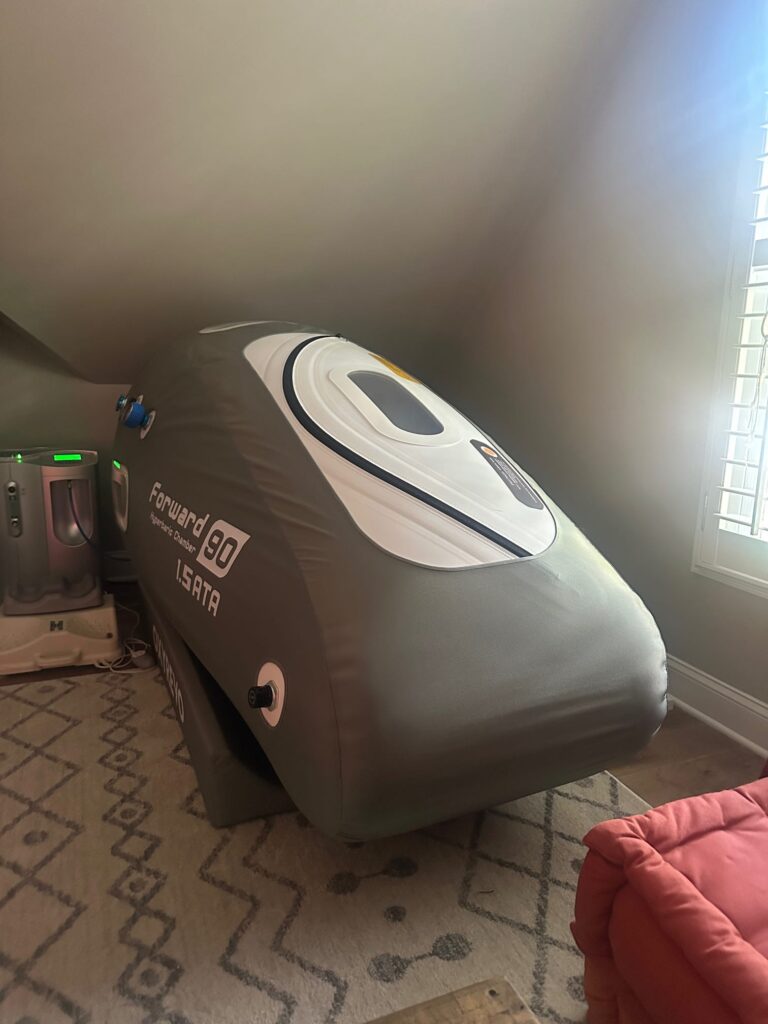
I purchased a home hyperbaric chamber and currently use it regularly.
Of all the advanced therapies I’ve explored, HBOT is one of the few where I noticed clear and measurable effects.
Among the changes I personally observed:
- Improved motivation and drive
- Better exercise recovery
- Improved HRV
- Lower inflammatory markers
- Increased sense of well-being
My hs-CRP dropped dramatically during the period I was using HBOT consistently.
Was HBOT solely responsible?
Impossible to know.
But the timing certainly caught my attention.
Today, HBOT remains one of the therapeutic tools I value most.
Limitations of HBOT
HBOT is not inexpensive.
Challenges include:
- Equipment cost
- Time commitment
- Access
- Space requirements
The protocols used in research studies often involve:
- 40–60 sessions
- Daily treatments
- Higher pressures than many home units provide
As a result, real-world results may vary considerably.
HBOT should be viewed as a supplement to foundational health practices, not a replacement for them.
Sauna Therapy
If HBOT is my favorite oxygen-based intervention, sauna is my favorite heat-based intervention.
And unlike HBOT, sauna is supported by a remarkably large body of epidemiological research.
Why Sauna Is So Interesting
The strongest evidence comes from Finland, where sauna use has been part of daily life for generations.
Researchers observed that individuals who used a sauna frequently experienced substantially lower rates of:
- Cardiovascular disease
- Stroke
- All-cause mortality
- Dementia
- Alzheimer’s disease
The relationship appeared dose-dependent.
In other words:
The more frequently people used a sauna, the greater the observed benefit.
Potential Mechanisms
Several mechanisms may explain these findings.
Improved Vascular Function
Heat exposure improves endothelial function and vascular flexibility.
Many researchers now believe vascular health and brain health are inseparable.
Increased Heat Shock Proteins
Sauna stimulates the production of heat shock proteins.
These proteins help repair damaged cellular proteins and improve resilience under stress.
Reduced Inflammation
Regular sauna use has been associated with reductions in inflammatory markers.
Improved Insulin Sensitivity
Heat exposure may support glucose metabolism and metabolic flexibility.
Cardiovascular Conditioning
A sauna session produces physiological effects similar to moderate exercise:
- Increased heart rate
- Increased circulation
- Improved vascular responsiveness
Stress Reduction
Many people experience significant relaxation and nervous system down-regulation following sauna use.
Dementia and Alzheimer’s Research
The most frequently cited studies come from:
Jari Laukkanen
His research demonstrated that frequent sauna users had dramatically lower rates of dementia and Alzheimer’s disease compared with infrequent users.
While observational studies cannot prove causation, the consistency of the findings has generated substantial interest among researchers.
Finnish vs Infrared Sauna
This is one of the most common questions I receive.
Traditional Finnish Sauna
Advantages:
- Higher temperatures
- Better heat shock protein response
- Stronger cardiovascular stimulus
- Most closely resembles research protocols
Infrared Sauna
Advantages:
- Lower temperatures
- Greater comfort
- Easier tolerance
- Often less expensive
Both likely provide benefits.
If your goal is to mimic the protocols used in much of the published research, traditional Finnish sauna probably has the stronger evidence base.
My Sauna Experience
I enjoy sauna therapy and use it regularly.
However, I learned an important lesson through trial and error.
Late-evening sauna sessions often worsen my sleep.
Many people report the opposite.
For me, the heat exposure appears to activate rather than relax my system.
Moving sauna sessions earlier in the day solved the problem.
As with so many things in prevention, personalization matters.
HBOT vs Sauna
People often ask which one I would choose if forced to pick only one.
For most people:
Sauna wins.
Why?
Because it is:
- Less expensive
- Better studied
- Easier to access
- Associated with impressive long-term outcomes
However, if someone already has the fundamentals in place and is looking for a more aggressive intervention aimed specifically at cerebral blood flow, neuroplasticity, and recovery, HBOT becomes extremely compelling.
Ideally, they are not competitors.
They are complementary tools.
My Takeaway
If you are struggling with glucose control, poor sleep, inactivity, obesity, uncontrolled blood pressure, or elevated ApoB, I would focus there first.
The fundamentals produce the greatest return on effort.
But once those pieces are largely in place, HBOT and sauna become worthy additions to the conversation.
Of all the advanced therapeutic tools I’ve explored, these are the two I find most compelling.
Neither offers a guara
Don’t Dismiss the Price Too Quickly
When people first look at the cost of a hyperbaric chamber, their initial reaction is often immediate sticker shock.
I understand. I had exactly the same reaction.
But before dismissing HBOT as “too expensive,” I would encourage you to view it the same way you might evaluate a vehicle, a swimming pool, a home gym, or even a family vacation.
The true cost is not the purchase price.
The true cost is the cost per use.
A chamber that costs $10,000 and is used three times per week for ten years by two people results in more than 3,000 sessions. Suddenly, the cost per session looks very different.
Unlike many wellness expenses that disappear the moment they are purchased, a hyperbaric chamber may continue providing value for years or even decades. Some owners also recover a meaningful portion of their investment through resale.
I’m not suggesting HBOT is inexpensive. It isn’t.
What I am suggesting is that the headline purchase price often causes people to reject the idea before performing the math.
Therapeutic Tool Cost Per Session Calculator
Advanced tools such as HBOT chambers and saunas can look expensive at first. This calculator helps estimate the real cost when spread across financing, years of useful use, frequency of use, and number of users.